The chair method of sleep training

The chair method is a way of sleep training where you stay in the room with your baby. It’s also called gradual retreat, camping out, the disappearing chair and graduated withdrawal. Kim West’s Sleep Lady Shuffle gets called the chair method too.

You put your baby in the cot awake and sit on a chair beside them until they’re asleep. You move the chair further from the cot every few nights, toward the door, until you’re out of the room.

Where the chair goes each night

Keep a hand on their back at first if they’re used to that. Start taking it away before they fall asleep.

The HSE

You’re out of arm’s reach now, so settle them with your voice.

Kim West, on her Shuffle

Keep using your voice to settle them.

Kim West, on her Shuffle

Leave the door open so they can still see you.

How Baby Nap Track runs it

Say goodnight and leave the room.

The HSE

Every night in the chair

What to do when

Your baby cries

An NHS leaflet from Wigan says to go over and gently pat or stroke them, then go back to the chair as soon as the crying stops.4 Kim West, the family therapist behind the Sleep Lady Shuffle, adds shushing and humming.2 The HSE says to do only what you feel comfortable with.1

You want to pick them up

You can always pick your baby up to calm them. That’s Kim West’s rule, and the catch is to put them down again before they fall asleep. If you find you’re picking up a lot, she says to spend one or two more nights beside the cot before the chair moves.8 Cleveland Clinic’s version says to leave them in the cot.3

They stand up in the cot

Kim West’s answer is to pat the mattress and encourage them to lie down. They’re more likely to do it if you’re sitting, because that puts them at your eye level. Lay them down yourself once at most, she says, and practise getting down from standing during the day.9

They wake in the night

Go back to the chair and sit until they’re asleep again. Cleveland Clinic, KidsHealth New Zealand and Sleep Action in Scotland all give that step.367

They’re sick

Leave the chair where it is until they’re better, and answer them straight away at night. You may need to move it back a place or two once they’ve recovered. This is Kim West’s advice.10

It’s nap time

Use the same chair places for naps as you do at bedtime, as Kim West does.11

Your toddler is in a bed

The HSE’s steps are written for a cot or a bed.1 If your child is used to you lying on the bed, Sleep Action says your first step is onto the chair.6 An NHS trust in Essex gives steps in between: lie on the covers, then sit up, then sit with your feet over the edge, then kneel on a cushion beside the bed.5 KidsHealth New Zealand says to tell a child who starts playing that you’ll only stay if they lie down, and to leave for a minute or two if they carry on.7

You share a bedroom

Sit by the cot for three nights, then on your own bed or by the door, then in the hall. Kim West suggests a screen, or a sheet hung like a wall, if seeing you in bed confuses your baby.11

Baby Nap Track

The app can take you through it

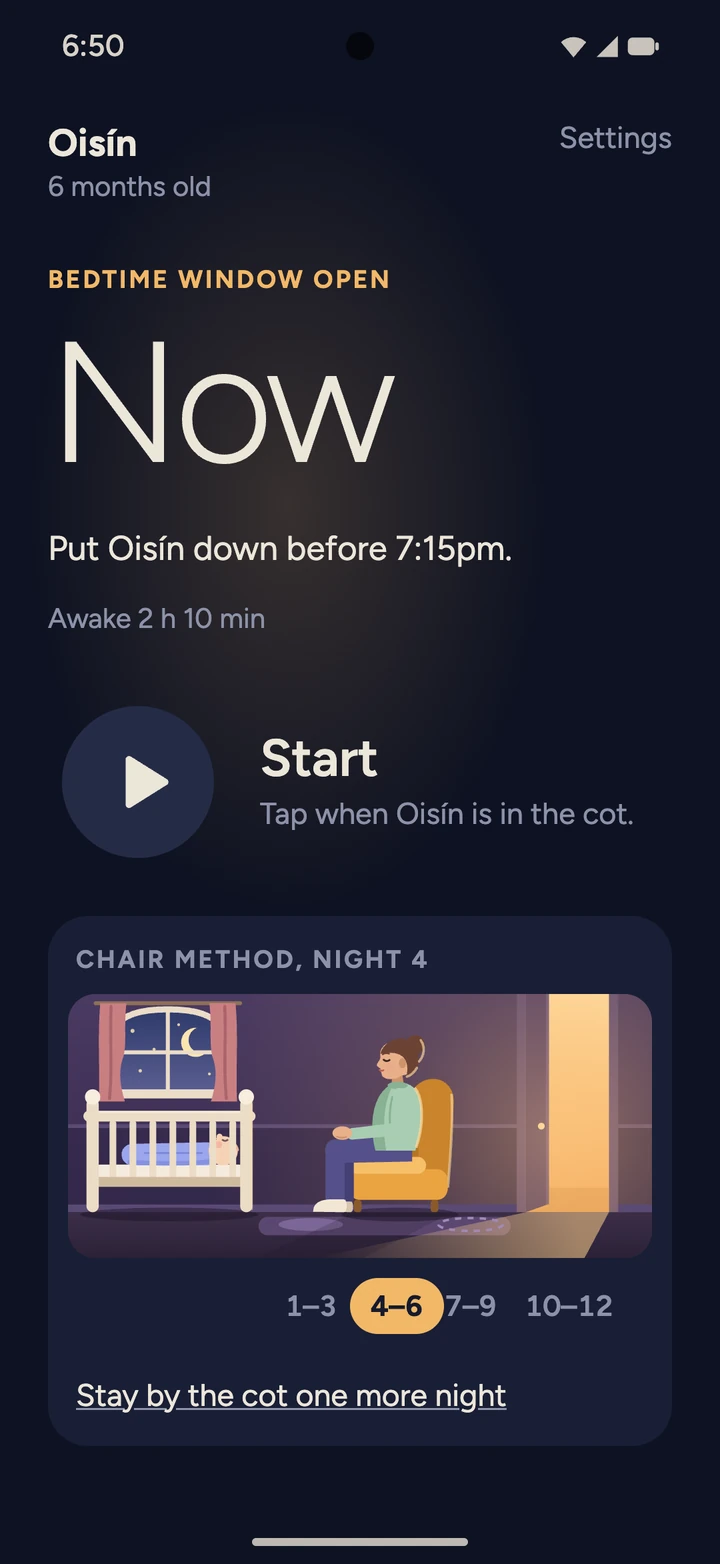
Turn on the chair method in Settings and it keeps count of the nights for you.

Get it on Google Play
Bedtime on night 4 of the chair method: a picture of a parent in a chair halfway between the cot and the door, and a Start button to tap when Oisín is in the cot.
At bedtime it shows where the chair goes tonight and times how long your baby takes to fall asleep.
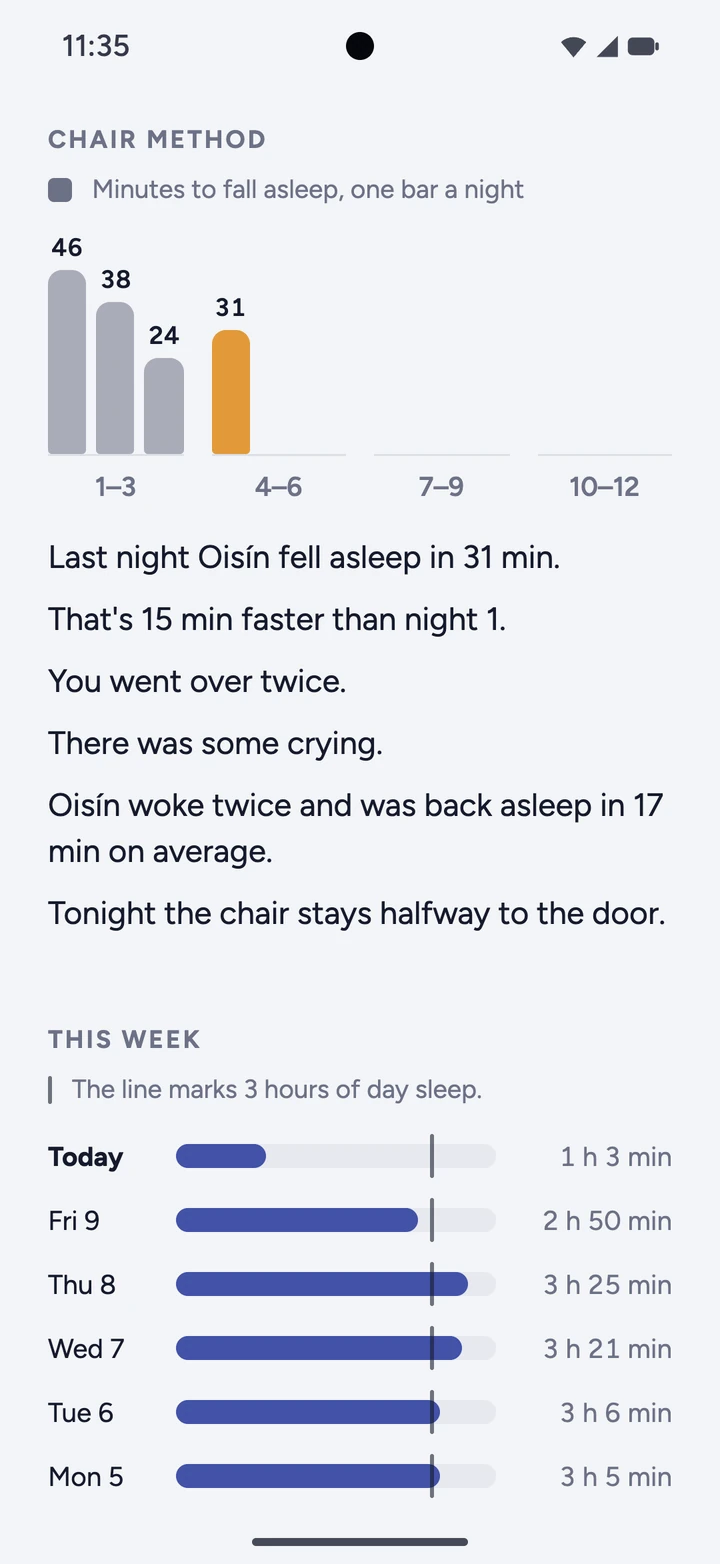
The morning after: a chart with one bar for each night, and last night Oisín fell asleep in 31 minutes, 15 minutes faster than night 1.
In the morning a chart has a bar for every night.

Questions

How long does the chair method take?

You’re in the chair for twelve nights and you leave the room on night 13. That’s three nights at each place, which is how Baby Nap Track runs it. Kim West says most families see a change within 7 to 10 days of starting her Sleep Lady Shuffle.2

WhoWhen the chair moves
An NHS leaflet in Wigan4Every night, or each time the crying stops
KidsHealth New Zealand7Every 2 nights, by a metre
Baby Nap Track’s planEvery 3 nights
The HSE1Every 3 to 4 nights
An NHS trust in Essex5Every 4th night
Sleep Action in Scotland6After days or weeks at each place
Took 3 nights until he slept through. First night was horrendous though.One parent of a ten month old, on Mumsnet16

What age can you start?

The HSE suggests it from six months.1 Kim West says her Shuffle works for children from 6 months to 6 years.2 The Wigan leaflet is for children over 12 months, and KidsHealth New Zealand uses it with primary school children.47 A trial in Melbourne taught it to parents of babies aged 8 to 10 months.13

Is it the same as the Ferber method?

With Ferber you leave the room and come back to check after waits that get longer. His chart runs seven nights. With the chair method you stay in the room, and this plan runs thirteen nights.

Compare all 16 methods

Is it the same as the Sleep Lady Shuffle?

Kim West says they differ. She calls sitting by the cot without responding the chair method, and in her Shuffle you comfort your baby from the chair. The HSE’s steps have you comfort them too.12

Does it work?

A trial in Melbourne let parents choose between the chair method and controlled crying. 56% of those mothers said their baby had a sleep problem at ten months, against 68% of mothers who got the usual care.12 The trial counted the two methods together. It found no lasting effect at age six, good or bad.13

Matthey and Črnčec’s 2012 trial of 16 families found it worked as well as controlled crying.14

Other names for it

The HSE calls it gradual retreat in Ireland, and so does an NHS trust in Essex.15 Health visitors in Wigan call it the disappearing chair.4 In Scotland it’s graduated withdrawal, in a leaflet from the charity Sleep Action that NHS Lothian’s health visitors hand out.6 Australia and New Zealand call it camping out, and KidsHealth New Zealand offers a camp bed in place of the chair.712 Matthey and Črnčec’s trial called it parental presence.14 Cleveland Clinic calls it the chair method.3

Where it came from

Sleep researchers were testing it by the 1990s. Gwen Dewar’s review at Parenting Science lists a study of 50 babies at Tel Aviv University in 1994, then an Icelandic hospital study in 2003 and trials in 2012, 2020 and 2022.1415

Nurses in Melbourne taught it to parents as camping out in a trial published in 2007.12 Kim West says she designed her Sleep Lady Shuffle close to 30 years ago.2

Sources

  1. HSE. Helping your child get back to sleep, 6 months and older. www2.hse.ie
  2. Kim West. The Sleep Lady Shuffle, sleeplady.com, and her page on how it differs from the chair method, sleeplady.com
  3. Cleveland Clinic. How to do the chair method of sleep training for babies. health.clevelandclinic.org
  4. Wrightington, Wigan and Leigh NHS Foundation Trust, Health Visiting Team. Disappearing Chair technique, leaflet CM 154, 2019. wwl.nhs.uk
  5. Essex Partnership University NHS Foundation Trust. Gradual retreat method. eput.nhs.uk
  6. Sleep Action, for NHS Lothian health visitors. Graduated withdrawal. services.nhslothian.scot
  7. KidsHealth New Zealand. Camping out method for managing sleep problems. kidshealth.org.nz
  8. Kim West. How much should my baby cry during sleep coaching? sleeplady.com
  9. Kim West. My baby learned to stand in his crib and now he won’t sleep. sleeplady.com
  10. Kim West. How to get your baby back to sleep after being sick. sleeplady.com
  11. Kim West. Sleep training while room sharing. sleeplady.com
  12. Hiscock, Bayer, Gold, Hampton, Ukoumunne and Wake. Improving infant sleep and maternal mental health: a cluster randomised trial. Archives of Disease in Childhood, 2007. pmc.ncbi.nlm.nih.gov
  13. Price, Wake, Ukoumunne and Hiscock. Five-year follow-up of harms and benefits of behavioral infant sleep intervention. Pediatrics, 2012. doi.org/10.1542/peds.2011-3467
  14. Gwen Dewar. Infant sleep training: gentle alternatives to cry it out. Parenting Science, 2022. parentingscience.com
  15. Sadeh. Assessment of intervention for infant night waking. Journal of Consulting and Clinical Psychology, 1994. pubmed.ncbi.nlm.nih.gov
  16. Mumsnet. Disappearing chair method, success stories? mumsnet.com